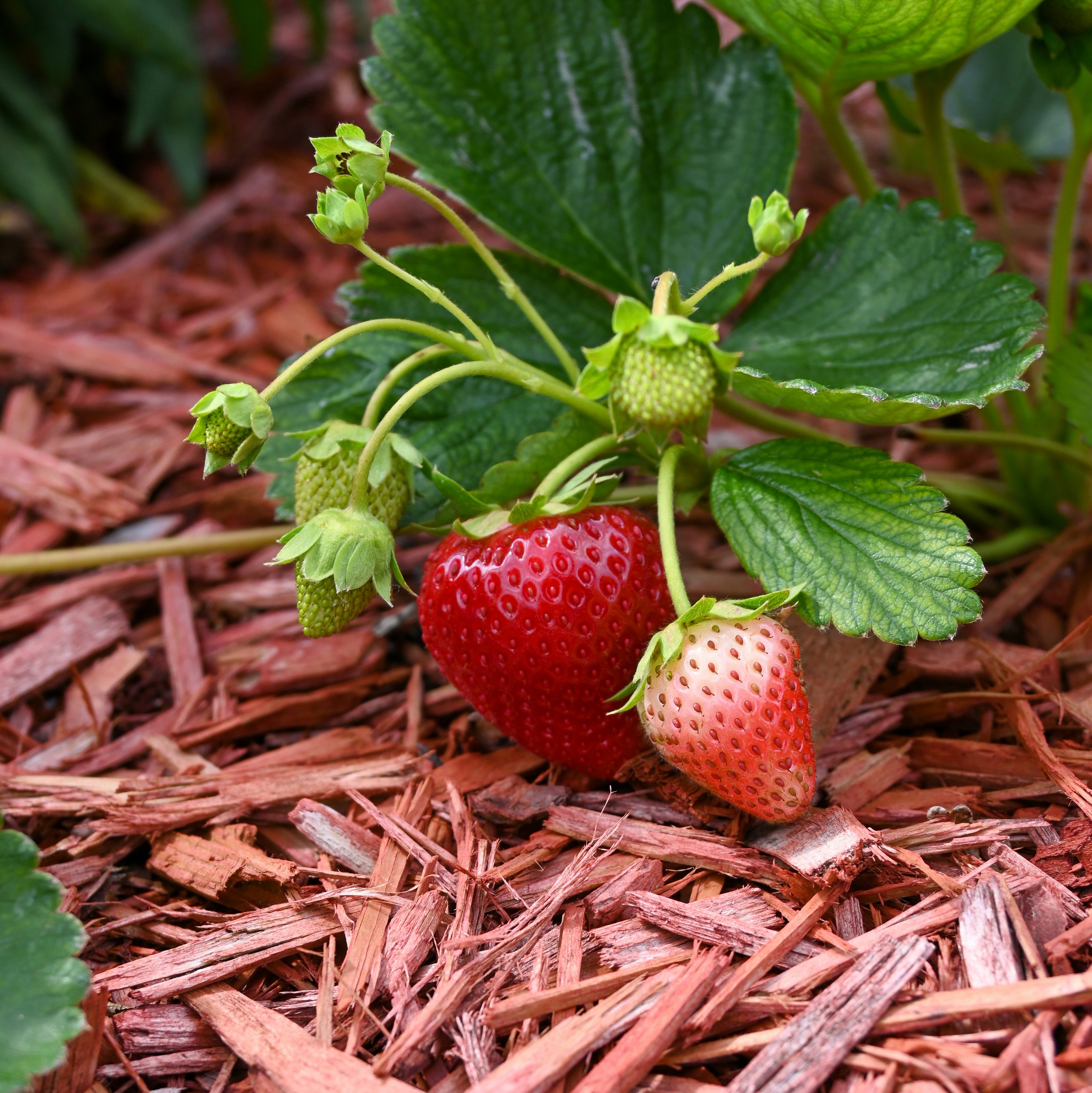
My family is just starting out on this adventure to re-connect with nature, and move away from societal reliance. We’ve decided to take a close look at our habits and resources and how we can better connect with the life cycle, becoming more sustainable and less consumable.
And it all started with a strawberry plant
My favorite part of spring and summer is the berry season. If you’ve been to the grocery store lately, berries are one of the most expensive fruits even when they’re in season. Then you go to the garden center and you see the price of strawberry plants, you’ve probably thought: What would it actually take to grow my own? That thought stuck with me.

Throughout my life I found myself buying strawberry plants, and then having no idea how to care for it let alone get it to produce fruit.
At first, I didn’t even know how a strawberry bore fruit. My childhood obsession with strawberries was clearly passed down to my children who, if given the opportunity, will eat an entire box of strawberries in just a few days. And don’t get me started on the strawberry jam situation in my house.
Even when we were renting, we would find some way to growing strawberry plants in our home. We had limited success with the first few plants, which we had planted in containers. It turns out strawberries needs different treatment when planted in a container. Strawberries in containers dry out much faster than those in the ground and generally need daily watering, while in-ground plants typically do fine with two to three waterings per week (Bushel and Berry, n.d.). That was news to us at the time.
Our second trial of strawberry plants went directly in the garden soil. And for us, made all the difference. For the first time, we actually had fruit blossom and develop into medium sized strawberries, which were promptly eaten by our toddler. Fair enough.
When we moved I was sad to say goodbye to our garden, but happy that it might bring someone else joy. Shopping for our first home space for a garden was at the top of our priority list.
And our very first garden plant? Strawberries, of course.
Starting Small
We started with a two or three small strawberry plants in the backyard.
We planted them directly in the ground with plenty of space between them. Looking back, what I had consistently underestimated in earlier attempts was water.

After researching strawberries I found information that backed up what we were starting to figure out on our own: consistent moisture is critical, especially from the moment flowers appear until the fruit ripens. According to the Old Farmer’s Almanac (2024), strawberries need the equivalent of about one to one and a half inches of water per week under normal conditions, and more during hot, dry spells. I started having the kids water the plants every other day when temperatures hovered around 80°F, and every day when it climbed above 90°F. The routine worked well for us.
As with all plants that are watered by hand: try to water at the base of the plant rather than overhead, and water in the morning so any moisture on the leaves has time to dry before nightfall. Wet foliage overnight can encourage fungal disease (University of Minnesota Extension, 2022). And if you live in a hot arid environment watering plants near the leaves can cause leaves to be burned even in the late morning, so the earlier in the morning you water the better.
I’ll be honest sometimes it just works out to water in the evening, after the sun has already started to descend, my schedule doesn’t always allow me to water in the morning with getting kids ready for school and hard start time with my employer all the chores just don’t get done. So if you live in an area that gets very hot very early, watering in the evening isn’t the worse case scenario, especially if you aren’t able to water just at the based of the plant.

But be mindful that overnight watering can still cause fungal diseases, and an increase in pest activity.
Our next research topic was fertilizer, one that contains nitrogen, phosphorus, and potassium. One thing we learned the hard way: do not fertilize certain strawberry types when the plant is at peak flowering. Apply fertilizer in early summer and again in fall (Bushel and Berry, n.d.).
We also found that our specific type of strawberry plants do well when fed every 6-8 weeks during the summer. We used this fertilizing blend because its organic and ready for both indoor and outdoor plants. It is a concentrate so dilute according to the directions. I prefer to use a feeder that attaches to the hose makes it much easier to fertilize throughout the garden.
Learning About Strawberries
Although strawberries have been a lifelong obsession, it was surprising how much I really didn’t know about them. I had grown up around strawberry patches, and thought I knew the basics. Strawberries grew close to the ground and farmers planted them in rows. That was about the extent of my information.
Once I started digging into how they actually work, I discovered that strawberries are much more interesting than they appear.
How strawberries reproduce is one of the coolest things about them. Yes, they have seeds, and a surprising quantity of them all around the berry.
But growing strawberries from seed is slow, unreliable, and often disappointing, because most modern strawberries are hybrids and the seedlings won’t necessarily resemble the parent plant (The Old Farmer’s Almanac, 2024).

The much more efficient method is through its runners, also called stolons. When a strawberry plant enters its reproductive phase, it sends out long, horizontal stems along the soil surface. At intervals along these stems, small clusters of leaves form. I have seen plants produce 2 -3 clusters and if those nodes make contact with the soil, they develop roots and grow into an entirely new, genetically identical daughter plant (University of Minnesota Extension, n.d.).
Once the daughter plant establishes its own root system, the runner connecting it to the mother plant dries up and falls away on its own. This is exactly how our two or three little starter plants turned into over fifty plants lining the back fence over just a few seasons. It was amazing to witness nature doing its thing, completely on its own terms.
A word of caution, though: runners take a lot of energy away from the mother plant, which means unchecked runners can actually reduce your fruit yield. If your goal is maximum berry production, it’s worth trimming back the runners or directing only a few of them into the soil where you want new plants to establish (StrawberryPlants.org, 2022).
We let ours run free, and we ended up with more plants, but you’d be surprised how quickly those plants started producing fruit.
These plants gave my kids their favorite food all throughout summer without stores, preservatives, or bug sprays. And we gather enough strawberries to jar them and freeze them to use throughout the year.
Types of Strawberry Plants
Three types, different behaviors. There are three main types of strawberry plants: June-bearing (one big harvest in late spring), everbearing (two to three harvests across the season), and day-neutral (continuous production from spring through fall). Knowing which type you have helps you plan watering, fertilizing, and runner management (HOSS, n.d.).
We have day-neutral berry plants, which provide an continuous production from late March to early October. Needless to say, we might go a few days to a week without summer strawberries after the first harvest but for the past two years I’ve been able to go out and pick strawberries almost everyday.


Sun is non-negotiable. Strawberries need at least six to eight hours of direct sunlight per day , more is better. The more sun they get, the more fruit they produce (Bonnie Plants, 2023). This is why they thrive in hot environments when given sufficient water.
Spacing matters. Plants do best when spaced about a foot apart to leave room for runners to spread without overcrowding. Crowded beds have reduced air circulation, which can lead to fungal issues (Old Farmer’s Almanac, 2024). The fungal issues will start when the leaves of the plant start to turn brown. That’s why its important to remove debree from around the plant.
Despite strawberry fruit being delicate, the plants are surprisingly tough. A layer of straw mulch applied before the winter frost begins can help strawberries survive winters (University of Minnesota Extension, 2022). They go dormant, slow their growth, and bounce back in spring. In warm climates without hard freezes, they may stay semi-evergreen like the plants in our garden. Our plants have survived and returned year after year, which always feels like a small miracle.
We’ve had to relocate our strawberry patch more than once as our garden layout evolved, and the plants handled the transition remarkably well each time. As long as they were transferred into good soil with adequate water, they bounced back. This made sense with their resilience, strawberries are adaptable.
Strawberry Topping
For the past couple of years, our little patch has produced enough fruit to make around eight batches of strawberry preserves. We had enough to last us through the winter. One of the best feelings I’ve ever had is knowing I was feeding my family something I grew myself.

This recipe couldn’t be simpler:
Ingredients:
- 2–3 cups fresh strawberries
- 1½ cups sugar (or substitute monk fruit sweetener for a lower-sugar version)
Instructions:
- Remove from heat and allow to cool completely before transferring to jars or freezer bags.
2. Rinse the strawberries in a diluted vinegar-and-water solution to clean them naturally.
3. Hull the berries and mash them in a saucepan.
4. Heat over medium-low, stirring as the berries begin to soften and release their juices.
5. Once the mixture starts to warm, add the sugar and stir to combine.
6. The sugar reacts with the natural acidity of the strawberries, drawing out more juice as it dissolves — you’ll see the mixture turn glossy and fragrant.
7. Simmer on low for 10–15 minutes, stirring occasionally. Don’t let it scorch.
8. Let the strawberries cool and place in a bag to freeze or jar.
Strawberry Summary
Despite my early struggles, strawberries really are one of the most beginner-friendly fruits you can grow. As long as you give them consistent water, plenty of sun, and a little patience, they’ll reward you with far more than you expect.
What started as one small plant has become one of my family’s most meaningful hobbies. My kids water the plants, watch the blossoms form, check daily for ripe berries, and help make the preserves. They understand now, in a very tangible way, where food comes from and what it takes to grow it.
Disclosure: Some of the links in this post are ‘affiliate links’. This means if you click on the link and purchase the item, I will receive an affiliate commission.
References:
Bonnie Plants. (2023). Growing strawberries. https://bonnieplants.com/blogs/how-to-grow/growing-strawberries
Bushel and Berry. (n.d.). Strawberry planting & care. https://www.bushelandberry.com/strawberry-care
Colorado State University Extension. (2023). Strawberries for the home garden. https://extension.colostate.edu/topic-areas/yard-garden/strawberries-for-the-home-garden-7-000/
HOSS Tools. (n.d.). Strawberry growing guide. https://growhoss.com/blogs/growing-guides/strawberry-growing-guide
Old Farmer’s Almanac. (2024). How to grow strawberries. https://www.almanac.com/plant/strawberries
Oregon State University Extension Service. (2023). Growing strawberries in your home garden. https://extension.oregonstate.edu/catalog/ec-1307-growing-strawberries-your-home-garden
StrawberryPlants.org. (2022). What are strawberry runners (stolons)? https://strawberryplants.org/what-are-strawberry-runners-stolons/
University of Minnesota Extension. (2022). Growing strawberries in the home garden. https://extension.umn.edu/fruit/growing-strawberries-home-garden
University of Minnesota Extension. (n.d.). How strawberry plants grow. https://extension.umn.edu/strawberry-farming/how-strawberry-plants-grow
Photo by Oliver Hale, 50m. above, Glennice Burns, Yun Cho on Unsplash

Leave a Reply