Choosing a seed type for your garden is a deeply personal decision, especially for homestead gardeners. The seeds you select reflect your values, your goals, and your vision for what a sustainable life looks like for you and your family.
I’ve been on this mission to identify my family’s food cycle. I’m hoping to know exactly where our food comes from, and the process it goes through to get to our table. So I’ve started a produce and herb garden, and researching sustainable gardening techniques. Seed selection is a primary starting point.
Organic Seeds
“Organic” describes how a seed was grown, not its lineage. These seeds are produced according to organic farming standards. These standards are set by the USDA. Seeds labeled as certified organic must have been produced on farms that adhere to the USDA’s National Organic Program (NOP) standards. The parent plants were grown without synthetic pesticides, herbicides, fungicides, or fertilizers, and the seeds were processed without prohibited chemical treatments (USDA Agricultural Marketing Service, 2013).
One important clarification worth making: organic seeds are not the same as genetically modified (GMO) seeds, and they never can be. Under USDA NOP regulations, genetically engineered seeds are explicitly prohibited from use in certified organic farming (USDA AMS, 2013).
Genetically Modified Seeds
Genetically Modified or Bioengineered seeds are not typically seen in the home garden section of retail stores, they are used in industrial farming. So you don’t need to worry about the seeds you found in the garden section of your favorite project store.

However, if your planting seeds from produce you purchased at the local grocery store, there is a chance they may be genetically modified or bioengineered. In the industrial farming industry these seeds are used to enhance size, taste, color, or repel pests.
Hybrid Seeds
What you will find in the garis that many organic seeds in stores are from hybrids. These are plant varieties created through controlled cross-pollination of two parent plants to produce offspring with specific desirable traits. Hybridization is a natural process, not a laboratory one, and it has been practiced by plant breeders and farmers for centuries (Nature’s Path, n.d.; Bountiful Gardener, n.d.). The trade-off with hybrids is that their saved seeds won’t grow to be the same as the parent plant, the next generation will be unpredictable, so you’d need to buy new seeds each year if your looking for those plant qualities (Sow True Seed, 2020).

When planting hybrid seeds you might find that the plant looks different, grows differently, and it’s produce may not look or taste the same from seed to seed.
Hybrid seeds are commonly bred for large-scale commercial agriculture with traits such as uniformity, high yield, longer shelf life, and resistance to mechanical harvesting. Many of the fruits and vegetables in grocery stores come from hybrid varieties selected for appearance and durability rather than flavor (Hudson Valley Seed, 2023). This is not a judgment just the facts. There are real reasons hybrids exist, our need for commercial agriculture to feed urban development is real. But it does explain why homegrown heirloom varieties often taste better than what you find in a store.
I started my very first windowsill herb garden with organic seeds back in our apartment and it just felt so good to grow something I could put in our food. Organic was my starting place while I was still learning the differences and distinctions between seeds.
Typically when you find heirloom seeds they are organic. I definitely don’t want to damage my heirloom seeds so I make sure that all of the materials I use in my garden are organic. And usually as “homemade” as possible.
What is an Heirloom Seed?
Think of heirloom seeds as living history. These are plant varieties that have been cultivated, selected, and carefully passed down through generations. They are often passed down through specific families, communities, or regions for 50 years or more, with many varieties traceable back centuries (Seed Savers Exchange, 2025; Hudson Valley Seed, 2023).
What makes them special? Open Pollination. Heirloom seeds are always open-pollinated, they reproduce using the wind, insects, birds, or self-pollination. Creating seeds that are genetically “true” to type.

If you save seeds from an heirloom tomato and plant them next season, you’ll get the same tomato, with the same flavor, color, and characteristics, year after year (Baker Creek Rare Seeds, 2025; Sow True Seed, 2020).
This is the foundation of traditional seed saving, a practice that sustained agriculture before modern commercial farming. Heirloom seeds carry not just genetic information but cultural history. Families saved the seeds of specific varieties because of their taste, aesthetics, disease resistance, or adaptability to local growing conditions (Hudson Valley Seed, 2023).
Personally, I love the idea of planting something that has survived generations and to take part in a tradition that was likely part of our own history. To me, heirloom seeds are the living endangered species of the gardening world, they are irreplaceable, and worth protecting. Heirloom seeds are a representation of sustainability, which is a family goal.

You won’t find these seeds in your neighborhood garden center, and seeds that come from produce at your local grocery are not heirloom seeds. Heirloom seeds come from dedicated seed companies, you can find them online and surprisingly affordable. This year I will be planting medicinal herbs using heirloom seeds.
Our First Season with Heirloom Seeds
When I first started our garden, I knew it was going to be a passion project. I wanted to garden the old-fashioned way, with traditional methods of fertilization, pruning, harvest, and seed saving. I wanted seeds that reflected our family’s commitment to sustainable, intentional living.
We planted heirloom varieties of cherry tomatoes, cucumbers, carrots, onion, and watermelon. Heirloom plants tend to be leafier than their commercial counterparts, they grow with their full natural energy, putting as much into foliage as fruit. Our yield that first season genuinely fed us through the winter, but I’m hoping to learn more about pruning heirloom varieties.
The cherry tomatoes alone produced over seven batches of tomato sauce, and I dried several trays for soups using our dehydrator. The cucumbers went into salads and smoothies. The kids ate the carrots almost immediately which was fun to watch. Our onions kept growing so well that plants are still producing three years later. And the watermelon, I had never tasted anything like it. So sweet, so juicy. It was one of those experiences that reminds you why this whole endeavor is worth it.
The whole gardening experience was exactly what I wanted for my family garden. I will never regret using heirloom seeds.
Reasons to Use Both
Heirloom and Organic qualities are not mutually exclusive. Heirloom seeds are often also grown and sold as certified organic, because the values behind heirloom seed saving align naturally with organic growing. Even though I have personally chosen to use only organic materials in my garden, it is significantly important because I use heirloom seeds and wouldn’t want to damage the reproductive cycle of these amazing plants.
That said, finding every vegetable or herb you want in an heirloom variety can be challenging. When I can’t locate an heirloom variety for something I want to have in my garden, I’ll use a certified organic seed instead. It’s a practical approach to building the garden I actually want to support our families growing sustainable lifestyle.
The Magic of Open-Pollination
I have found that the heirloom seeds are amazing with natural open-pollination. They interact freely with their environment. After planting cherry tomatoes in one of my raised beds, I then had cherry tomato plants sprouting for the next three seasons. Seeds that had fallen, overwintered in the soil, and germinated on their own. The first two seasons we made the most of every tomato. I know cherry tomatoes are not the most versatile variety. But I made tomato sauce that turned out really good. I also used a dehydrator to dry some tomatoes to use in soups. An amazing addition during the colder months.

By the third and fourth seasons, I was actively trying to rotate that bed for other crops and was weeding out tomato plants so I wouldn’t strip the soil. (I am still learning about crop rotation and soil nutrition)
Growing the same plant family in the same spot year after year depletes soil nutrients and creates spaces for pests and disease to build up over time. Rotating crops ideally every three to four years helps maintain soil health, reduces pest pressure naturally, and improves overall yields (Rodale Institute, 2025; Clemson University Extension, 2025; USDA, n.d.). For us, this meant it was time to give that raised bed a rest from tomatoes and let something new grow. Our favorite garden plants support our favorite salsa dish, Pico De Gallo. Check out the post on the specific plants needed to make this amazing, and healthy dish.
Where to Find Heirloom Seeds
For quality heirloom and open-pollinated seeds worth exploring here are a few resources.
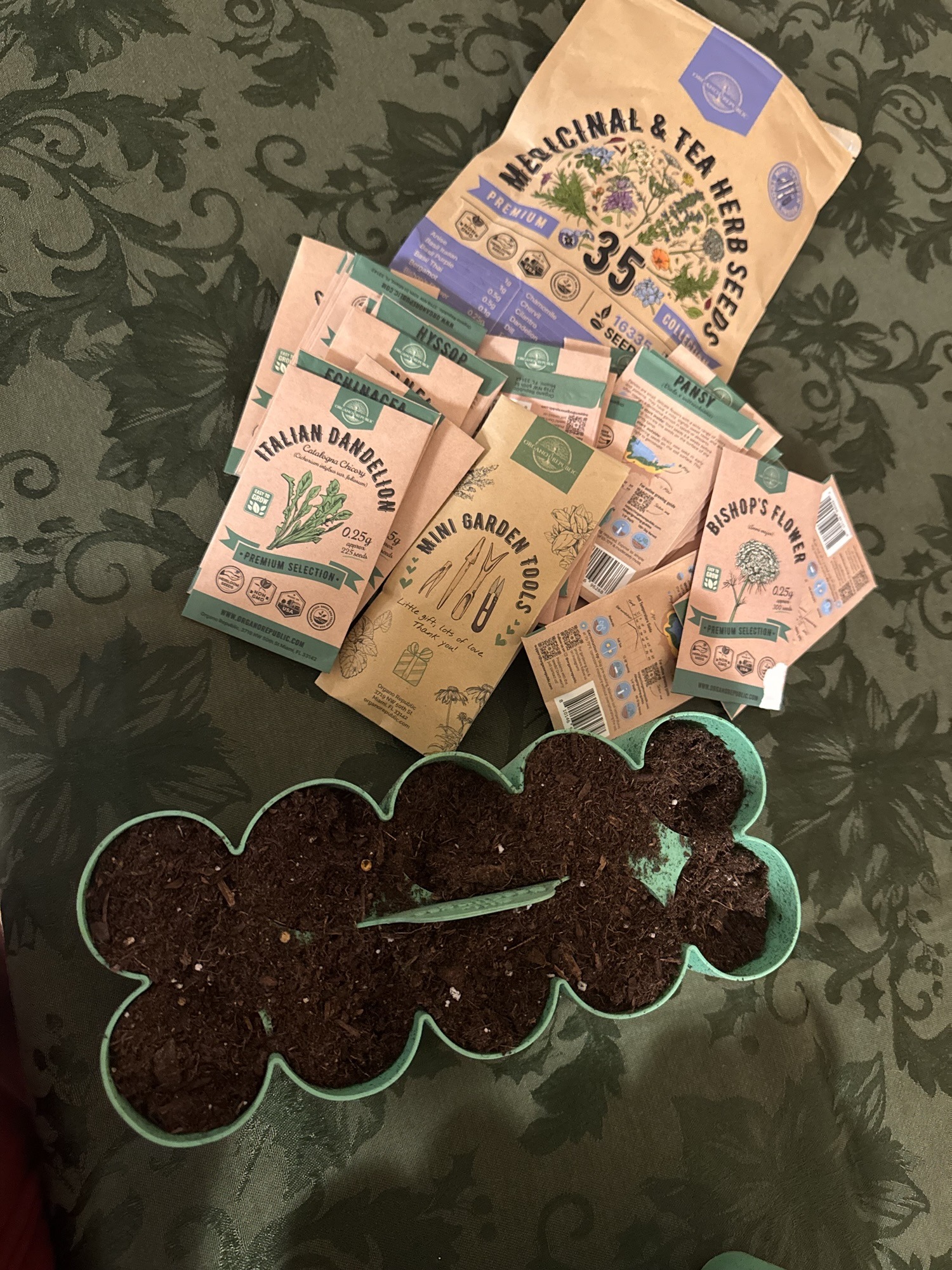
Organo Republic (organorepublic.com) I’ll be trying their variety of seeds for my medicinal garden.
Open Seed Vault (open-seed-vault.com) These were the first seeds I used in my garden.
Seed Savers Exchange (seedsavers.org)
Baker Creek Rare Seeds (rareseeds.com)
Hudson Valley Seed (hudsonvalleyseed.com)
Sow True Seed (sowtrueseed.com)
As you settle in to your garden adventure, explore the world of seed varieties. Save seeds when you can. Notice which plants thrive in your specific soil and climate, and let your garden evolve naturally from there.
References
Baker Creek Rare Seeds. (2025). Heirloom, open pollinated, patented: A glossary of terms. https://www.rareseeds.com/blog/post/heirloom-open-pollinated-patented-a-glossary-of-terms
Bountiful Gardener. (n.d.). 7 facts about heirloom, open-pollinated, and hybrid seeds. https://www.bountifulgardener.com/facts-about-heirloom-open-pollinated-and-hybrid-seeds/
Clemson University Extension. (2025). Crop rotation. Home & Garden Information Center. https://hgic.clemson.edu/factsheet/crop-rotation/
Hudson Valley Seed. (2023). Heirloom, open pollinated, or hybrid? https://hudsonvalleyseed.com/blogs/blog/heirloom-open-pollinated-or-hybrid
Nature’s Path. (n.d.). The difference between heirloom, open pollinated, and hybrid organic seeds. https://naturespath.com/blogs/posts/difference-between-heirlooms-open-pollinated-and-hybrid-organic-seeds
Rodale Institute. (2025). Crop rotations. https://rodaleinstitute.org/why-organic/organic-farming-practices/crop-rotations/
Seed Savers Exchange. (2025). What are heirloom seeds? https://seedsavers.org/what-are-heirloom-seeds/
Sow True Seed. (2020). Open-pollinated, heirloom, hybrid, GMO: A terminology guide. https://sowtrueseed.com/blogs/gardening/open-pollinated-heirloom-hybrid-gmo-a-terminology-guide
USDA Agricultural Marketing Service. (2013). Seeds, annual seedlings, and planting stock in organic crop production (NOP 5029). https://www.ams.usda.gov/rules-regulations/organic/handbook/5029
USDA. (n.d.). Cover crops and crop rotation. People’s Garden — Soil Health. https://www.usda.gov/about-usda/general-information/initiatives-and-highlighted-programs/peoples-garden/soil-health/cover-crops-and-crop-rotation
Photo Credits:
Photo by Annie Spratt, Jenna Lee, Abdul Hameed, thuong uyen dinh on Unsplash.
Original Photos by Suburban Homesteads LLC
Disclosure: Some of the links in this post are ‘affiliate links’. This means if you click on the link and purchase the item, I will receive an affiliate commission.

Leave a Reply