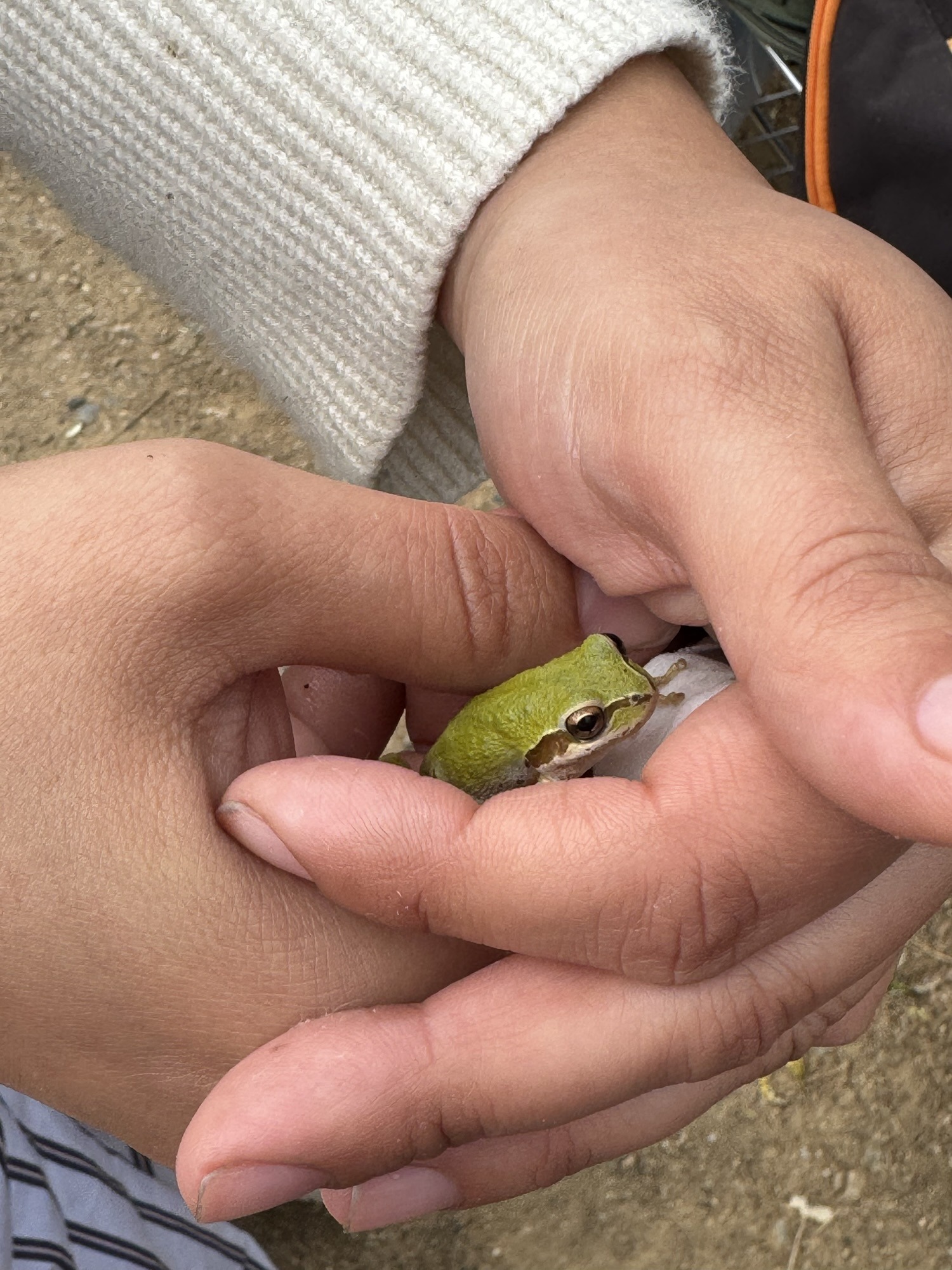
The second most important survival skill to pass down to the next generation is identifying your surroundings. This includes plants, insects, and animals. It’s part of a bigger, more essential skill: finding food safely. When our kids can tell a poisonous plant from an edible one, they’ve gained a skill that can’t be taught just sitting in a classroom; it must be experienced. And it leads to confidence that they can survive longer and safer in unpredictable situations.
In our last post, we talked about filtering water as the number one survival skill because, let’s face it, you can’t survive without water. Which leads to the next survival skill of finding food, and this becomes more complicated because of how many plants and animals are poisonous. So finding food is really a multi-step skill that we want to learn and pass down through the generations.
Identification, or in essence research, is the first step in this survival skill, which we practice during family camping trips and is especially important to practice for those of us living in the suburbs, constantly surrounded by convenience. One of the biggest challenges I face as a parent is motivating my children to learn survival skills when the grocery store is ten minutes away, and the refrigerator is full of food.
That’s exactly why camping trips are a priority for our family. This “vacation” may be one of the only opportunities we get to teach these skills in a way that feels like a meaningful family event instead of homework or chores.
The Tools We Use, Both Old and New

When I was young, I loved science, and hands-on learning was always my preferred way of learning. My parents invested in a series of Audubon field guides, and that’s how I learned to identify trees, flowers, insects, and so much more.
Technology has made identifying nature much easier. With AI, you can snap a photo and get information on almost anything you’re curious about, and there are plenty of apps built specifically for identifying plants, insects, and animals. Personally, I like two apps to help me out in the garden and help teach my kids when we’re camping.
The first is PictureThis, a plant identification app that’s popular for its plant care tips, though many of its features require a subscription.


The second app we use is Seek, which is part of iNaturalist. Seek was built with backing from the California Academy of Sciences and the National Geographic Society, and it’s completely free, with no ads or in-app purchases.
What I love about it is that when our family documents an observation through iNaturalist, we’re contributing to a global citizen-science effort. Seek uses the same enormous database of crowdsourced nature observations that iNaturalist has built from millions of users worldwide. The data helps researchers and has even led to the discovery of new species. I love the idea that our family is contributing to actual science while practicing our survival skills.
Why We Use Both Methods
Our family combines both the low-tech and high-tech methods because each has value. Apps are quick, fit in your pocket, and good at narrowing down the search, but they’re not perfect. Seek’s own community has documented plenty of funny mistakes. So we cross-reference the app’s findings with our Audubon field guides.

The Audubon guides provide a pictorial description and a page reference with more detailed information: flowering patterns, leaf shape, habitat, region, and uses, if any.
Personally, when using the apps, I have encountered one or two misidentifications out of about twenty, usually because of a blurry photo or an immature plant. But that’s exactly why we make cross-referencing a habit. This is a skill I want my kids to carry into how they use the internet more broadly. I don’t want them to accept everything they find online or in an app as automatically correct. There are too many instances where information turns out to be incomplete or simply wrong. That’s the real purpose behind teaching them to combine manual research with technology and allow them to develop well-rounded skills.
An Important Safety Note on Plant Identification
Before I describe how we practice this at the campsite, I want to be transparent about this skill: identifying a plant with an app or field guide is not the same as knowing it’s safe to eat. There is a big difference between practicing survival skills and having the knowledge to determine what’s safe.
Poison control centers consistently advise that only experienced botanists and serious students of edible plants can reliably tell the difference between what’s edible, inedible, or outright toxic, and that even adults have been seriously poisoned by confusing a toxic plant for something they believed was edible.
Our family’s non-negotiable rule: never put any part of a wild plant in the mouth, and we never assume a plant is safe just because we’ve identified it. If we’re ever unsure whether something is toxic, which at this stage of our skill level is almost everything, we treat it as if it’s toxic until we can verify it through a reliable source.
If anyone ever does ingest something questionable, Poison Control (1-800-222-1222) is the number to call immediately, since a specific identification, ideally down to the scientific name, is what lets them help quickly. This is one area where the goal of the activity isn’t foraging. It’s building the observational and research habits that would matter in a genuine survival situation.
How We Develop Identification Skills While Camping
Ok, let’s talk about the fun stuff. When we arrive at our campsite and get our shelter set up, the first thing we do is take a walk around and look at all the different plants nearby. We ask the kids to look at the leaves, look at the flowers (if they’re in bloom). We ask them to pay attention to the shape and texture of the leaves and stem.
Then we take a photo and upload it to PictureThis. When we first started, I’d simply ask my kids to find out whether the plant was toxic to people or pets, and talk about why knowing whether a plant is toxic, or which parts of it are toxic, matters to the health and safety of the whole family.


After all, you don’t want to set up camp in the middle of poison oak. Unfortunately, I’ve had my own experiences with poison oak and stinging nettle, neither of which was pleasant. Just another reason I believe in being able to identify plants.
As kids get older and become more familiar with the idea, we start talking about the patterns of toxic versus non-toxic plants. And start asking the questions before uploading the pictures or checking the field guide. One good question to ask is, “What features do you see that make you think this plant is toxic or non-toxic?”
After our last trip, we printed out the photos of what we’d observed and organized them into a notebook, pasting a picture on each page. Then we had the kids write down their observations of the plant: color, leaf size, whether it was a large or small plant, single or multiple blooms. After that, we looked up the plant in the Audubon guide and added details about its habitat or origin.

Projects like these teach so many overlapping skills at once: observation, research, identification, and, ultimately, survival skills.
Insects: Small Creatures Leave Big Clues
The next area we focus on is insects. One reason we identify insects is that they can lead us to food and water sources. For example, dragonflies are usually found near water, since their larvae are aquatic and need clean, oxygen-rich water to develop, so spotting them is a decent hint that water isn’t far away.


Insects themselves can also be a source of nutrition in a true survival scenario. In fact, entomophagy (eating insects) is a normal part of the diet in many cultures around the world and is often praised as a sustainable protein source. But as with everything found in the wild, caution is worth teaching kids early: even insects that aren’t toxic themselves can be unsafe if they’ve fed on something toxic, and wild-caught insects can carry parasites, bacteria, or pesticide residue. Farmed, food-grade insects don’t carry these same risks.
Again, when practicing our identification skills, we do not eat anything we’ve found in the wild. So with insects, just like with plants, identification is step one, and “would this be safe to actually eat” is a separate and more serious question.
Animals: Reading the Signs They Leave Behind


Identifying animals themselves may be the easier task on a hike, but identifying their tracks is more complex, and it’s an important skill, especially if you’re trying to locate food sources or figure out what might be sharing your campsite.
We’ve started teaching our kids to look for a few basics: the type of print, its size, the number of toes, and the pattern of the stride. It’s a slower skill to build than plant or insect identification, but it rewards patience, and it turns an ordinary hike into a bit of a detective story.

There are also resources to help build these skills. When I first started looking for activities to teach survival skills, I found some activity books that really interested my kids and gave a good introduction to observing tracks and the differences between animals.
Disclosure: Some of the links in this post are ‘affiliate links’. This means if you click on the link and purchase the item, I will receive an affiliate commission.
Resources
- California Academy of Sciences and iNaturalist on the Seek app
- National Capital Poison Center and Children’s Hospital of Philadelphia on plant identification and poison safety
- Institute of Food Technologists and peer-reviewed research on edible insect safety
- National Park Service and wildlife tracking guides on animal track identification


Leave a Reply