Our family started this suburban homestead journey to live a more sustainable life, and the first area we changed was our diet, removing the preservatives and toxins that have crept into our shelf-stable, store-bought food, and now it’s time to change our hygiene.
We realized that the next step we needed to take was addressing the personal hygiene products, which also have a fair amount of overly processed and toxic ingredients. The problem for me was having little ones running around and time being scarce, so making my own hygiene products from scratch felt daunting.
That’s when I set my mind to tackling the problems one step at a time. I decided to start with just three areas.
Hair Care
I remember the first time I tried making my own shampoo. I didn’t have kids yet, and I still felt like I was failing a chemistry assignment. Now that I do have kids, trying to formulate a shampoo and conditioner with six or more ingredients and get the consistency just right hasn’t worked, and quite frankly, I have no time for it. But that doesn’t mean I haven’t been able to reduce or eliminate many toxins and carcinogens from our hair routine.

I grew up in a household where you washed your hair every time you showered, and as you can imagine, my hair became very dry, brittle, and damaged. On top of that, I had to take medication that made my hair thin and changed its texture entirely. I was so embarrassed by my hair hygiene I would just stick it in a ponytail so I didn’t have to think about it.
And I’m not the greatest at making pony tails look cute and stylish, so most of the time I just looked like I had very little hair. I needed to relearn how to actually take care of my hair, the right way.
Now, I will admit I’m not really a “go see the doctor” type of person, but lately I’ve been put into situations where doctor’s appointments (all kinds of doctors) are a regular occurrence. I had read in several different places that you didn’t need to wash your hair every day, or every other day, and I really only needed to wash my hair once every two weeks. That seemed like poor hygiene to me.
So, I asked a professional, and the answer was surprising. As a matter of fact, you really only need to wash your hair 1-2 times per month, and sometimes you can wait even longer if it’s well cared for in between washes.
I also didn’t need a complicated shampoo recipe. I simply wanted to use natural, organic ingredients to wash and condition my hair. If you’re interested in how I developed my routine and what I use, check out my post on using single ingredients for hair care.
Oral Hygiene
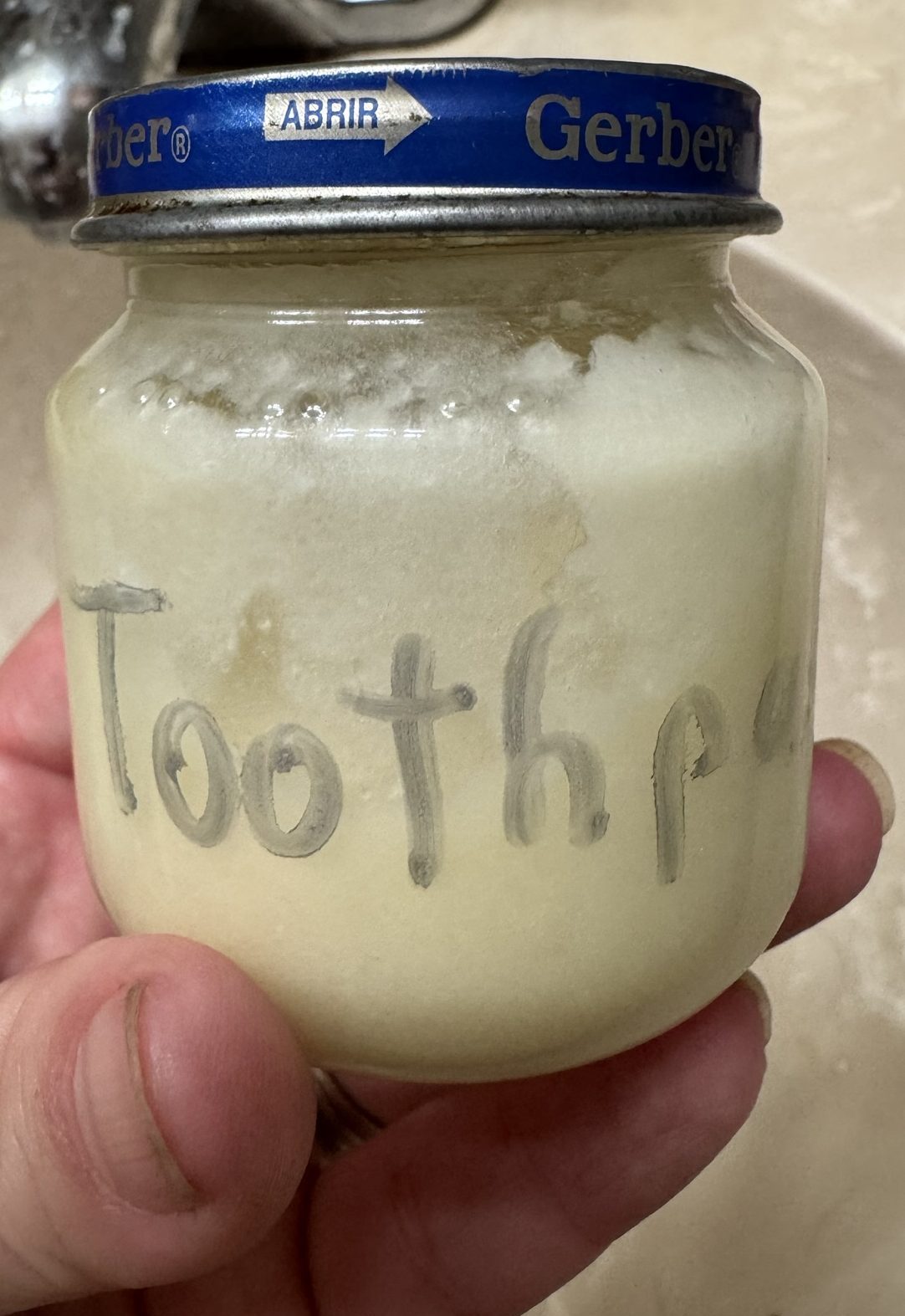
Homemade toothpaste and mouthwash: this is one homemade product I’ve used for years without any problems. In fact, my dentist has always been surprised by the health of my teeth and gums.

So what makes the biggest difference between homemade toothpaste and store-bought? Well, traditionally dentists don’t recommend homemade toothpaste as part of good oral hygiene, and it’s not because it isn’t healthy; it’s because fluoride is an ingredient that has the most benefits regardless of the recent controversy on its overall health impact.
But when it comes to store-bought toothpaste, there are ingredients we need to look out for and avoid. SLS (sodium lauryl sulfate), which creates foam to help circulate toothpaste but has little actual cleaning power; some people get canker sores or mouth-tissue peeling in as little as one use. A randomized study found significantly more canker sores in people using SLS toothpaste compared to SLS-free versions, and separate research recorded visible tissue peeling on the gums of most participants using SLS toothpaste for just a few days. That tracks with something I’ve experienced myself, that feeling like a layer of my cheek was peeling after brushing my teeth.
Triclosan is an ingredient that has largely phased out of US toothpaste, and Colgate reformulated their toothpaste to remove it. But if you use older tubes of toothpaste, you may still find it listed in the ingredients. The FDA has flagged it for links to thyroid hormone disruption in animal studies and for contributing to antibiotic resistance. On a separate note, it was banned from antibacterial hand soaps in 2016.
Titanium dioxide, a whitening/opacity agent having no recorded health benefit, is used purely for cosmetic effects. This is a genuine case where U.S. and European regulators disagree. The FDA still considers it safe and approved for toothpaste, food, and cosmetics. The EU, on the other hand, banned it as a food additive in 2022 after its food safety agency said it couldn’t rule out genotoxicity (potential damage to genetic material).
Personally, I’m in favor of the idea of proving an ingredient is safe before using it rather than waiting for someone to prove that it’s not safe. I want hygiene products that are safe from the inside out.
Artificial sweeteners (saccharin, aspartame) are used for flavor. In the case of Saccharin, the National Toxicology Program formally delisted it as a suspected carcinogen in 2000, and the FDA now regulates it as an approved food additive. But if you’re trying to keep additives out of your products, then it’s best to know that it is not a natural ingredient. Amounts in toothpaste are small, and it’s swallowed only incidentally.
Aspartame isn’t considered a meaningful cancer risk at normal consumption levels by any major food safety body, but the research is far from over. The amount of either sweetener in a dab of toothpaste is minuscule compared to what’s in a diet soda or a pack of gum, and toothpaste is meant to be spat out rather than swallowed. If you wanted a “no synthetic sweetener at all” stance for your homemade recipes, that’s a legitimate values-based choice.
There’s nothing wrong with homemade toothpaste, but there are some ingredients in some homemade recipes that are harsh and can cause damage. To read more about homemade oral care, check out my post on my oral hygiene with a toothpaste and mouthwash recipe.
Laundry Care

Believe it or not, your clothing and what you wash it in make a real impact on your health. Your skin is the body’s first line of defense, and when we’re constantly putting questionable ingredients on or in our clothing, our skin doesn’t have much choice but to absorb some of it.
We used to use a famous store-bought brand, but between the fragrance, dyes, and other ingredients, we switched to making our detergent. My husband was starting to break out from the store-bought brands, and my skin was so dry. It was clear these products were not supporting healthy hygiene. Our other problem was that if we skipped fabric softener in the dryer, the clothes came out stiff and scratchy. It felt like a losing cycle.
The ingredient list for a top brand liquid detergent includes water, several surfactants (including sodium lauryl sulfate), fragrance, and propylene glycol, among others. The good news: Consumer Reports did their own independent test of five different brand-name detergents and found that the level of 4-dioxane used in the manufacturing of these products was not measured at concerning levels. That’s not to say it wasn’t present, but the levels were less than what professionals determined to be toxic. They also did not find heavy metals, phthalates, or phosphorus.
What they did find were ingredients like SLS, common skin irritants and allergens worth checking labels for if you or your family have sensitive skin like mine. Another flag is fragrance. Under the Fair Packaging and Labeling Act, manufacturers are allowed to list an entire scent blend under the single word “fragrance” without disclosing the individual chemicals inside it, since fragrance formulas are treated as trade secrets.
That’s frustrating if you’re trying to avoid a specific allergen or irritant, since you genuinely can’t tell what’s in there from the label alone. And since it is a trade secret, they are under no obligation to reveal whether a carcinogen or other potentially toxic ingredient is used in the making of this “fragrance”. Especially considering it needs to be shelf-stable.
Optical brighteners (also called fluorescent whitening agents) are another ingredient to know about. They don’t clean anything; this additive is used to absorb UV light and re-emit it as visible blue light, creating the illusion of whiter fabric without removing any actual dirt or stains. They’re formulated specifically to bond to fabric fibers and resist rinsing out, which is exactly why some sources link them to skin irritation and contact dermatitis in people with eczema or sensitive skin. Although the findings and research in this case is thinner than it is for something like SLS, and manufacturers aren’t required to disclose optical brighteners on the label at all, so it’s hard to verify from a bottle alone.
Outside of detergent, the material itself is a huge factor. Polyester and nylon shed microplastics into waterways with every wash, on top of the chemicals used to produce the material in the first place.

The dyes used on synthetic fabrics are arguably the most concerning piece of the puzzle; clothing that combines synthetic fiber, dye, and finishing chemicals tends to be the most toxic combination in the closet. Cotton, by contrast, is a natural, biodegradable fiber that doesn’t contribute to microplastic pollution. There are still flaws with the farming and production of conventional cotton, but it is a far more sustainable choice. So as we are slowly changing our lifestyle practices, we are slowly changing our style as well.
We now make our own laundry detergent, but if you’re just looking for a quick replacement, the best single-ingredient detergent is washing soda. Interested in more about laundry and sustainable practices? Check out the post on reducing allergens and the benefits of homemade laundry detergent.
What We’ve Learned to Improve Our Hygiene
It’s a skill to learn how to make your own products, and it’s important to research every ingredient, not just the ones we get warned about through social media and the news. But it includes “natural” and “organic” ones too, since the wrong one can still do damage. The pursuit of going back to more natural, sustainable choices requires knowing what to use and how to use it safely. Hydrogen peroxide and baking soda are perfect examples: both are genuinely useful, and both can hurt your enamel and gums if you overdo it.
Still, the benefits of homemade products outweigh the downsides of most commercial ones, in more ways than one. Beyond the health angle of cutting out unnecessary processed ingredients, there’s a real monetary benefit: homemade toothpaste and hair care cost pennies on the dollar compared to commercial products, which gives us a little room to spend more on better clothing materials. Your skin will thank you for it later.
Resources
Oral Care
- American Dental Association. “Toothpastes.” ADA Oral Health Topics. ada.org
- U.S. Food and Drug Administration. “Skip the Antibacterial Soap; Use Plain Soap and Water.” fda.gov
- U.S. Food and Drug Administration. “Aspartame and Other Sweeteners in Food.” fda.gov
- World Health Organization / International Agency for Research on Cancer. “Aspartame Hazard and Risk Assessment Results Released” (July 14, 2023). who.int
- National Toxicology Program. Report on Carcinogens — Saccharin Delisting (9th Edition, 2000). ntp.niehs.nih.gov
- European Food Safety Authority. “Titanium Dioxide: E171 No Longer Considered Safe When Used as a Food Additive.” efsa.europa.eu
Laundry & Materials
- Consumer Reports. “How to Find an Eco-Friendly Laundry Detergent.” consumerreports.org
- U.S. Food and Drug Administration. “‘Trade Secret’ Ingredients” — Fragrances in Cosmetics. fda.gov
- California Senate Bill 258, Cleaning Product Right to Know Act of 2017. leginfo.legislature.ca.gov
- U.S. Environmental Protection Agency. “Final Risk Evaluation for 1,4-Dioxane” (TSCA). epa.gov

Leave a Reply