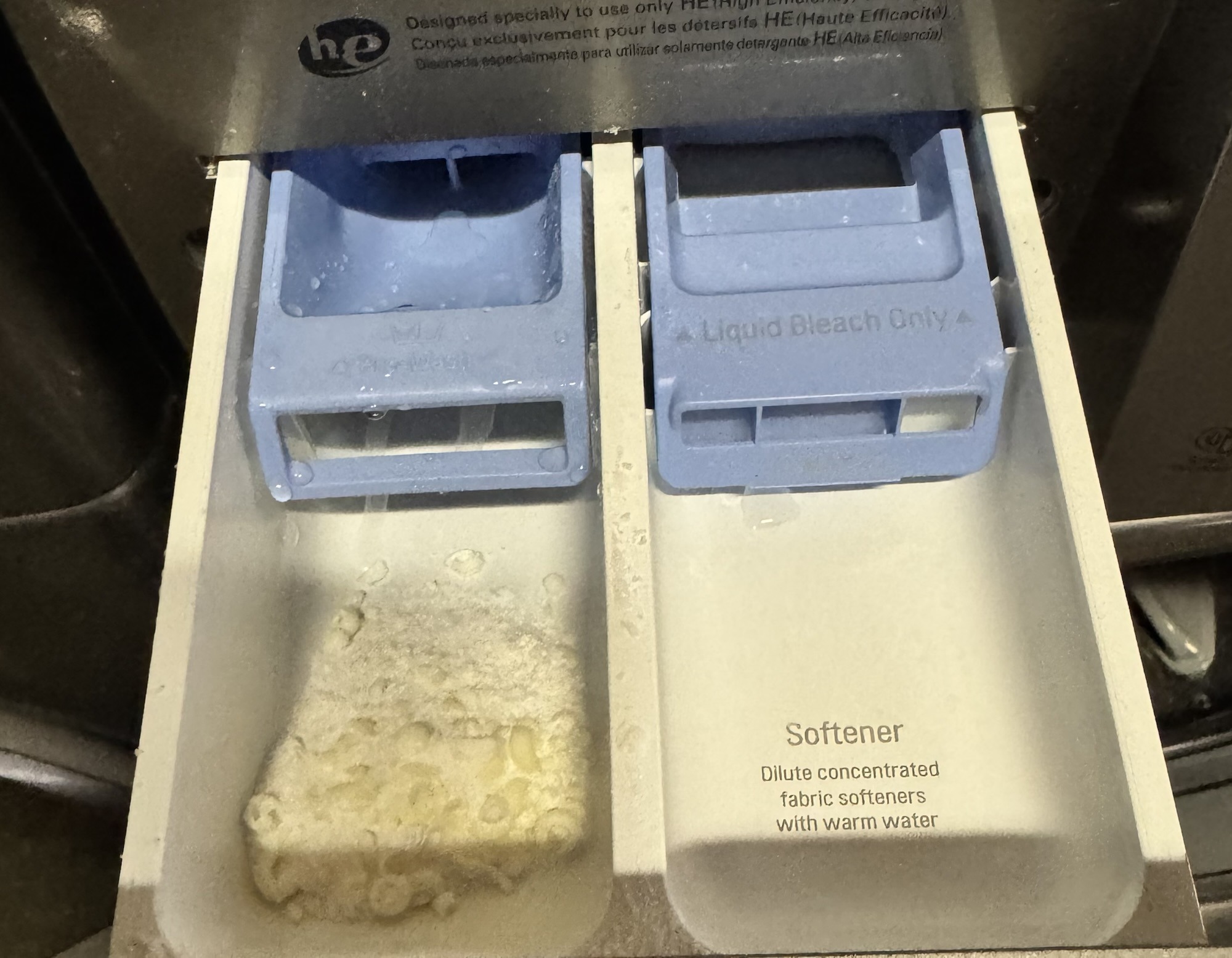
When I first started doing laundry, we only had liquid detergent and Oxiclean, and I always wondered why the detergent was blue. Then, as I grew up and started buying my own laundry detergent, I switched to pods because that’s what everyone was doing. Little did I know I was contributing to the skin sensitivities my family was slowly developing.
I’ve always wondered how we went from a bar of pure soap for laundry to cocktails of hundreds of ingredients just to wash our clothes. And how we all assumed that adding all of those ingredients wouldn’t cause some type of health problem.
My Skin’s Backstory
I’ve struggled with skin problems my whole life. Thousands of dollars went toward trying to fix it, and no one could ever really explain why. Hormones, diet, genetics, puberty: everything got blamed, and every “fix” targeted one of those imbalances. But of course, none of it worked in the long term. I’d read anything I could and listen to anyone who might have an opinion or remedy for my condition. Some said it was a sign of poor hygiene, which never made sense to me; we were always keeping our clothes, blankets, and linens clean. But of course, hygiene was never the real cause. For a long time, I tried to figure out what was making our skin frequently dry, why the clothing was sometimes itchy, and why we all developed what looked like acne on our bodies.
Honestly, I couldn’t tell you what kind of skin condition we had or whether our laundry detergent was the cause or just a contributing factor. There are many conditions where dermatologists don’t fully know what causes it, but many conditions lead back to genetics, not hygiene, so it was never a sign we were doing something wrong.
The point isn’t which diagnosis fits; it’s that harsh detergent chemicals sitting against your skin all day can aggravate whatever already going on underneath.
How This Relates to Detergent

Once I discovered our detergent was carrying dyes, shelf-stable preservatives, and a fragrance blend of its own undisclosed chemicals, I made the switch to homemade detergent.
And almost immediately, our skin started healing. The small bumps along our shoulders that we’d always assumed were from heat stopped showing up.
That is exactly where cutting fragrance and dye out of our routine made a physical difference. We were no longer dealing with the flare-ups of irritants to sensitive skin, or the self-consciousness of visible bumps across our shoulders. As it turns out, dermatologists specifically recommend hypoallergenic laundry products for people prone to sensitive skin. So while I was switching store-bought brands, each brand carried its own ingredients that were causing irritation. By switching detergents, I wasn’t actually targeting the problems, so I decided to look into making my own detergent.
Although it likely didn’t cure our condition, it did calm the irritation sitting on top of our skin, which is probably why our skin looked and felt so much better once the dyes and synthetic fragrance were gone.
Beyond the Skin
Aside from healing our skin, we’re no longer soaking our clothes, and by extension our skin, in synthetic chemical residue every day. We’ve moved to washing with natural ingredients that is better for our health and our bank account. Homemade detergent isn’t complicated, and once you switch, you’ll find you only need a couple of tablespoons per normal load.
I actually learned that ratio from a washing machine mechanic, who pointed out that most of us are using far more commercial detergent than our machines need anyway.

So let’s look at homemade detergent ingredients and break down their use and purpose.
Castile Soap vs. Dish Soap (like Dawn)
This comparison gets to the heart of what “soap” actually means. Castile soap is a true soap, its primary ingredient is oils (traditionally olive oil, though modern versions often blend in coconut, hemp, or jojoba) saponified with lye. Dawn and other dish soaps aren’t soap at all in the traditional sense; they’re synthetic detergents built around surfactants like sodium lauryl sulfate (SLS) or sodium laureth sulfate (SLES).
SLS is genuinely effective, it’s the reason Dawn cuts through baked-on grease where castile soap would require some scrubbing. But that same grease-cutting power comes from stripping away oils, and it doesn’t know the difference between grease on a pan and the natural lipid barrier on your skin. Dermatological studies show SLS reliably increases water loss through the skin and produces redness within days of exposure, even at low concentrations. SLS has been proven to be a reliable, reproducible irritant that researchers use as a standard tool for testing skin barrier function.
Castile soap won’t get your greasy sheet pan clean the way Dawn will, but for laundry, the goal is lifting dirt and body oils from fabric, not emulsifying bacon grease. That trade-off works in favor of laundry detergent: you get a plant-oil-based cleaner without the fragrance, dyes, or preservatives found in most commercial detergent ingredient lists.

Personally, I use Dr. Bronner’s Eucalyptus Castile soap. They use essential oils in the recipe, and eucalyptus oil has natural antimicrobial properties.
That’s especially helpful in the washing machine, where mold and mildew can become prevalent. So in a busy household where Mom has ADHD and forgets to empty the washer, eucalyptus can help prevent the clothes from smelling like mildew.
Borax vs. Oxiclean
Here’s where I have to be honest with you, because it complicates the story about natural ingredients.
Borax (sodium tetraborate) is a naturally occurring mineral, and it’s an effective laundry booster. It raises the pH of your wash water, softens it, and helps whiten and deodorize.

But “naturally occurring” doesn’t automatically mean “low concern.” In 2010, the European Union classified borax as a reproductive toxicant, restricting its sale to consumers. In animal studies Borax showed effects like reduced fertility and developmental changes at high, sustained doses. The key words here are high and sustained.
It’s still legal and widely sold in the U.S. The EPA classifies it as only “moderately” toxic, but the Environmental Working Group rates borax a D. For the same reproductive-toxicity concerns the EU had cited. That said, when it’s used as directed in a wash cycle, it dissolves and rinses away. So your actual exposure is minimal compared to the high-dose scenarios in those studies. The precautions for handling borax matter most when you’re handling the concentrated dry powder, not once it’s dissolved into a load. But when we’re talking about ingredients in our household products, it’s worth knowing the full story rather than assuming “natural” automatically means “safer.”
Meanwhile, Oxiclean is mostly sodium percarbonate, essentially powdered hydrogen peroxide bonded to washing soda. When it hits water, it breaks down into hydrogen peroxide and sodium carbonate, which is why EWG rates the active ingredient itself as low concern. Therefore, Oxiclean has a fairly clean toxicology profile. The catch is that the standard grocery-store version does include fragrance and dye. OxiClean Free and OxiClean Baby drop both and score noticeably better on EWG’s scale as a result.
So, is borax actually more natural than Oxiclean? Honestly, in my opinion, plain sodium percarbonate (or a dye-free Oxiclean) has a cleaner safety profile than borax does. Although Borax still earns its place in many sustainable cleaning recipes because it is a naturally occurring mineral. And because it’s used sparingly and rinses out cleanly, it remains a staple ingredient for good reason.
However, these two products are not interchangeable. Borax is a water softener that supports whitening and deodorizing clothing, whereas Oxiclean is more like a bleach alternative. If you have hard water, borax may be the best choice, but if you have soft water, then Oxiclean may be the better option.
Washing Soda vs. Baking Soda (and Regular Detergent)
Washing soda (sodium carbonate) and baking soda (sodium bicarbonate) sound like cousins, but they clean very differently. The difference comes down to pH: washing soda sits around 11, baking soda around 8.3. This surprisingly small difference makes a big impact. Sodium carbonate is a strong alkali capable of breaking down grease and softening hard water. Baking soda is a much gentler buffer that’s better at deodorizing than actually lifting stains or oils. You can’t simply substitute one for the other and expect the same results. Which is also why washing soda, like borax, isn’t something you want on bare or broken skin without rinsing.

Compared to a conventional powder or liquid detergent, washing soda’s biggest advantage is transparency. It’s one identifiable compound doing one job. Washing soda raises pH so surfactants and enzymes in the wash work harder.
Rather than a blend that may include optical brighteners, synthetic fragrance, and dyes that have no cleaning function.
What I’d Tell You If You’re Just Starting Out
None of these three ingredients is perfect, and that’s kind of the point. They’re all natural ingredients. Knowing what each one actually does, and whether there are truly health benefits, is better than assuming “natural equals safe.” Or thinking all store-bought cleaners are bad. That’s the bias I try not to fall into.
As I mentioned in my hair care post, I don’t have time for long processes or complicated recipes in my everyday routines. I save the intricate stuff for family meals; the regular chores need to stay as simple as possible. Much of what I learned about natural home cleaning came from digging into a book on natural housecleaning. Yep, I found it on Amazon, and it’s where this recipe started, although not where it finished.
The Detergent Recipe I Use
- 1 bar of shredded Castile soap
- 1 cup Borax or Oxiclean Free (Depending on your cleaning goals)
- 1 cup washing soda
Simple, right?
If your family deals with the kind of skin sensitivity ours does its worth trying. Or even if you’re just looking for a more sustainable, eco-friendly option, homemade laundry detergent is one of the easiest places to start.
Disclosure: Some of the links in this post are ‘affiliate links’. This means if you click on the link and purchase the item, I will receive an affiliate commission.
Resources
Löffler, H. et al. “Profile of irritant patch testing with detergents: sodium lauryl sulfate, sodium laureth sulfate and alkyl polyglucoside.” Contact Dermatitis, 2003. https://pubmed.ncbi.nlm.nih.gov/12641575/
Gloor, M. et al. “On the course of the irritant reaction after irritation with sodium lauryl sulphate.” Skin Research and Technology, 2004. https://pubmed.ncbi.nlm.nih.gov/15225263/
Environmental Working Group. “Borax: Not the Green Alternative It’s Cracked Up to Be.”
https://www.ewg.org/news-insights/news/borax-not-green-alternative-its-cracked-be
Environmental Working Group. Guide to Healthy Cleaning — Reproductive/Developmental Concerns. https://www.ewg.org/cleaners/content/reproductive/
Environmental Working Group. Sodium Carbonate Peroxide (OxiClean active ingredient) rating.
https://www.ewg.org/cleaners/substances/5511-SODIUMCARBONATEPEROXIDE/
Cleveland Clinic. “Keratosis Pilaris.” https://my.clevelandclinic.org/health/diseases/17758-keratosis-pilaris
Johns Hopkins Medicine. “Keratosis Pilaris.”
https://www.hopkinsmedicine.org/health/conditions-and-diseases/keratosis-pilaris
MedicalNewsToday. “Keratosis Pilaris: Causes, Symptoms, and Treatment.” https://www.medicalnewstoday.com/articles/318746

Leave a Reply