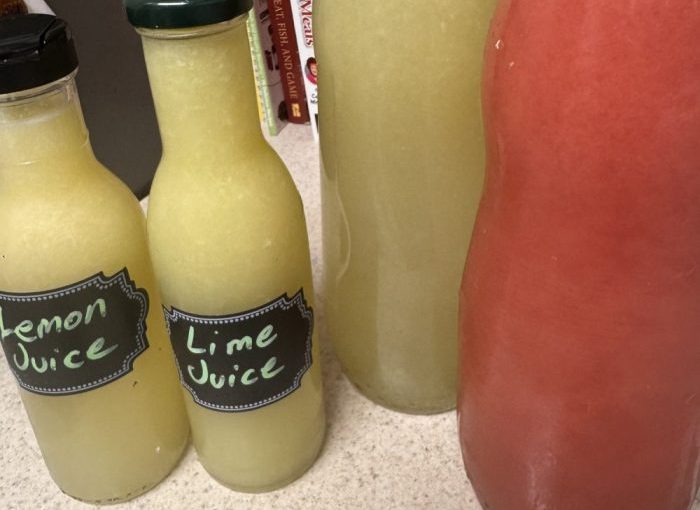
Juice is the drink of choice for most kids. Mine included. They ask for it on a daily basis, so how could we give them juice without sacrificing their health.
While I appreciate the health benefits that real fruit juice can offer, we knew it shouldn’t be their go to for hydration. Knowing how much my husband and I struggle with our health we started taking a closer look at the juice we were actually allowing them to drink.
Like many families, juice boxes and pouches were a regular purchase and a daily drink in our home. Over time, I started learning things that made me uneasy: the overall sugar content, the preservatives, and eventually the mold contamination scares tied to some packaged juice products. I had had enough of processed juice, and the more I learned about its long-term effects on kids, the more motivated I was to change what we were drinking.
When we were growing up, juice boxes and pouches were reserved for birthdays, class parties, and sports events. At home, half-gallon cartons were the norm, but my mother had a creative way of keeping our consumption in check. She ran a system of juice days and water days. Every other day we were allowed juice; on alternating days, it was water only. And if she caught you sneaking juice on a water day? Two consecutive water days. When I became a mother and struggles with the constant exposure to high sugar juice, I completely understand her thinking. I wouldn’t necessarily recommend her exact method, but the spirit behind it was sound.
Juice has overtaken children’s liquid consumption in a way that deserves real attention. As I started researching how I was going to change the juice problem in my house I learned that both the amount of juice and the type of juice mattered significantly.
Facts about fruit juice
Not all juice is created equal. There is a significant nutritional and health difference between fresh-squeezed juice, not-from-concentrate (NFC) refrigerated juice, reconstituted frozen concentrate, and boxed or pouched shelf-stable juice. Recent nutritional information suggests that sugary drinks, including 100% juice, should be limited significantly for young children, and the form of juice you choose makes an enormous difference in what your child is actually getting.
Boxed and Pouched Juice

Boxed and pouched juices are subjected to the most aggressive pasteurization of any commercial juice. They are processed through very high temperatures to achieve shelf stability for months. Research show these products suffer the greatest loss of vitamin C and antioxidant compounds. The vitamin most of use think is in these juices to support our kids immune system, has actually been burned out. The minerals like potassium, calcium, and magnesium are not affected by heat. (PMC, 2021; ScienceDirect, 2024)
Frozen Concentrated Juice
Frozen concentrate begins as freshly squeezed juice. Water is then removed through heat evaporation to create a thick syrup, the concentrate. Water is added back before packaging and shipping. The heat evaporation step is what causes the vitamins to diminish, particularly vitamin C, which is highly sensitive to heat. Researchers have documented losses of 17–22% of vitamin C when fruits are processed from whole juice through the concentration step. (Klopotek et al., 2005; Hartmann et al., 2008, cited in Nutrition Bulletin, 2025)

Frozen concentrate begins as freshly squeezed juice. Water is then removed through heat evaporation to create a thick syrup, the concentrate. Water is added back before packaging and shipping. The heat evaporation step is what causes the vitamins to diminish, particularly vitamin C, which is highly sensitive to heat. Researchers have documented losses of 17–22% of vitamin C when fruits are processed from whole juice through the concentration step. (Klopotek et al., 2005; Hartmann et al., 2008, cited in Nutrition Bulletin, 2025)
I grew up on the frozen concentrate lemonade and I remember scooping the syrup out of the container and into the jug to mix with water. As a kid I thought that was the best part, but little did I know I was secretly spiking my blood sugar and missing out on the the health benefits of real lemons.
Not-from-Concentrate (NFC) Refrigerated Juice

Not From Concentrate juice is freshly squeezed juice that is lightly pasteurized and packaged without the concentration step. It is labeled “not from concentrate” to signal to consumers that the juice has not gone through the evaporation process that degrades nutrients. NFC juice retains more flavor compounds and more of its original vitamins than concentrate-based juice, and it is the closest commercial equivalent to fresh-squeezed that most families can easily find.
Fresh-Squeezed Juice
Fresh-squeezed juice is pressed directly from whole fruit with no heat treatment. It contains the highest levels of heat-sensitive nutrients: vitamin C, polyphenols, flavonoids, and anthocyanins. But there is one additional element that makes fresh-squeezed especially valuable for children, and that is fiber.

Fresh-squeezed juice is pressed directly from whole fruit with no heat treatment. It contains the highest levels of heat-sensitive nutrients: vitamin C, polyphenols, flavonoids, and anthocyanins. But there is one additional element that makes fresh-squeezed especially valuable for children, and that is fiber.
When you retain the pulp in fresh-squeezed juice, you preserve the fiber content that makes fruit so nutritious in the first place. Juice without fiber does not “fill up” a child the way eating whole fruit does, which can lead to over-consumption of calories and sharp blood sugar spikes. When pulp is retained, the fiber slows sugar absorption, supports gut microbiome health, promotes digestive /regularity, and reduces long-term risk of cardiovascular disease and type 2 diabetes.
“When the fiber is stripped from the fruit to create juice, we are left with a product similar to a sugary soda. The body’s blood sugar response mimics that of a soda, and there can be consequences if the product is consumed too often” Rainie Carter, Clinical Nutritionist, Children’s of Alabama.
Current Guideline for Children’s Juice Consumption
Whole fruit is always the preferred choice over juice for children.
But that does not change how children will ask for juice on an almost daily basis. And as a parent it is very difficult to say no to what seems to be such a simple request. I think in our efforts to choose our battles with our kids, juice as a drink didn’t make that list. We thought it was healthy, I thought it’s still hydrating, little did I know I was infusing them with sugar and potentially causing more health problems in their future. Nutritional guidelines still hold that juice can be an option but it needs to be significantly limited when compared to my childhood.
These are the new guidelines for children’s maximum juice consumption.
- Children under 12 months should not be given juice, it has no nutritional benefit at this age.
- At the ages 1-3 years should have no more than 4 ounces of juice at maximum in a day.
- Children between the ages of 4 and 6 may have 4 to 6 ounces in a day.
- Youth ages 7 into adulthood may have 8 ounces of juice in one day.
While whole fruit is always the preferred method of fruit consumption, fresh squeezed juice with some pulp to retain the fiber content is a beneficial alternative. Even with the health benefits of fresh squeezed juice it should not be offered to our little ones throughout the day. One serving during a meal is probably the best approach.
Why Fresh Squeezed is Better
Changing how our family eats meant changing how we shopped. Instead of buying juice, we started buying whole fruit in larger quantities. You might assume that buying whole fruit is significantly more expensive, but it really isn’t, especially when you know where to look.
Here is a quick price comparison:
| Fruit Type | Fruit Storage | Retail Value | Price per cup |
| Oranges | Fresh | ~$1.40–1.72/lb | ~$0.40–0.60 |
| OJ – frozen concentrate (reconstituted) | Frozen concentrate | $3.99–4.28/12oz can | ~$0.50–0.65 |
| OJ – NFC store brand (89 oz jug) | NFC refrigerated | ~$7.42–8.99/jug | ~$0.66–0.80 |
Now, when it comes to buying whole fruit to make your own juice, the math gets interesting. Yes, buying enough fresh oranges to make multiple bottles of juice cost more per pound than a container of store-bought juice, but this is exactly where moderating the amount of juice given to kids makes the whole approach work beautifully.
If one 10lb bag of oranges, which at our local market is 8.99 gives us about 34 ounces of fresh-squeezed juice, then that single bag of oranges provides just the right amount of juice for two children for about 2 weeks. Kids should only have 4 ounces a day, and ideally thats only one to two servings per week The limitation built into the shopping routine and the natural yield of squeezing real fruit actually work together to solve the problem.
That is where preparing your shopping list becomes the best tool for a healthy family.
Our Monthly Shopping Approach
Our family shops roughly once a month for groceries, a necessity given our budget and strict payment schedule. On that trip, we buy one large bag of oranges, one large bag of lemons and limes, one large bag of grapefruit, and several other fruits not sold in bulk. We then plan how to prepare each fruit so nothing spoils before the month is up. Fresh-squeezed juice is one of the ways we extend those fruits and use every part of them.


We make one bottle of juice at a time using an electric juicer. My joints can’t handle the hand squeezer anymore! One bag of oranges gives us one bottle of juice plus a little extra. Once it’s gone, the kids know they will be waiting until the next batch is made before they can have juice again. That built-in scarcity is actually a gift: it teaches them that juice is not an everyday drink, it’s a process to make, and waiting for it is part of the experience.
Use the Whole Fruit
Any pulp that is strained out goes straight into the blender to become fruit leather. One way or another, they are getting the fiber from the fruit, it just might not be at the same time. And that feels like a win.
Zero-waste tip: Citrus peels are grated and dehydrated for zest, or added to the compost. One bag of fruit becomes juice, fruit leather, and zest with nothing wasted.


From a single bottle of lemon juice, approximately 24 ounces, we can make about three bottles of homemade lemonade, or use the juice throughout the month in recipes. If it isn’t finished, we freeze it for later. Nothing goes to waste.
Buying the Produce in Bulk
I’m still working on developing my own little orchard on our suburban homestead, but in the meantime we have found a better way to buy. We source as much of our produce as possible from local farm stands, in our neighborhood that means Ramos Country Corner or our local farmers market. And while oranges still run around $1.50 per pound, the quality and freshness we get from these sources makes a meaningful difference.
One of the most persistent myths in produce shopping is that farmers markets are always more expensive than grocery stores.
The Real Value of Making It Yourself
Making juice and fruit snacks at home supports both family health and your grocery budget. We have fundamentally changed the way we buy and prepare produce, and the shift toward being more self-sufficient, and less reliant on ready-made products, has been one of the most rewarding changes we’ve made.
Homemade fruit snacks: fruit leather, dehydrated fruit chips, whole fruit smoothies, these treats preserve far more nutrition than commercial juice while giving kids the fruity snacks they crave. Making snacks from whole fruit at home is a great family bonding activity and supports our efforts towards better nutrition.

Fresh Lemonade (Not from Concentrate)
Ingredients
Equipment
Method
- Using an electric juicer, juice approximately 3 medium lemons to equal 1 cup of lemon juice.
- Pour lemon juice into a 32 ounce glass bottle, add 3 cups of filtered water
- Add 3/4 cup of organic granulated sugar
- Stir or shake until sugar is dissolved.
- Chill in the refrigerator for two hours, serve cold.
Nutrition
Notes

Tried this recipe?
Let us know how it was!Disclosure: Some of the links in this post are ‘affiliate links’. This means if you click on the link and purchase the item, I will receive an affiliate commission.
Resources:
American Academy of Pediatrics. “Fruit Juice in Infants, Children, and Adolescents: Current Recommendations.” Pediatrics, June 2017. doi: 10.1542/peds.2017-0967 https://publications.aap.org/pediatrics/article/139/6/e20170967/38754/Fruit-Juice-in-Infants-Children-and-Adolescents
American Academy of Pediatrics. “AAP Recommends No Fruit Juice for Children Under 1 Year.” HealthyChildren.org. https://www.healthychildren.org/English/news/Pages/AAP-Recommends-No-Fruit-Juice-for-Children-Under-1-Year.aspx
American Academy of Pediatrics. “Fruit Juice in Infants, Children, and Adolescents: Current Recommendations (Full Policy Statement).” Pediatrics, 2017. https://publications.aap.org/pediatrics/article/139/6/e20170967/38754/Fruit-Juice-in-Infants-Children-and-Adolescents
Nguyen M, Jarvis SE, Chiavaroli L, et al.. “Consumption of 100% Fruit Juice and Body Weight in Children and Adults: A Systematic Review and Meta-Analysis.” JAMA Pediatrics, 2024;178(3):237–246. doi: 10.1001/jamapediatrics.2023.6124 https://pubmed.ncbi.nlm.nih.gov/38227336/
University of Utah Health. “Put Down the Juice: A Guideline to Healthier Options for Children.” University of Utah Health, 2024. https://healthcare.utah.edu/healthfeed/2024/05/put-down-juice-guideline-healthier-options
Juice Processing & Nutritional Science
[18] Wiley / British Nutrition Foundation. “Whole Fruits Versus 100% Fruit Juice: Revisiting the Evidence and Its Implications for US Healthy Dietary Recommendations.” Nutrition Bulletin, 2025. https://pmc.ncbi.nlm.nih.gov/articles/PMC12398644/
PMC / NCBI. “Impact of Innovative Technologies on the Content of Vitamin C and Its Bioavailability from Processed Fruit and Vegetable Products.” PMC, 2021. https://pmc.ncbi.nlm.nih.gov/articles/PMC7824742/
ScienceDirect. “Health Effects of Fruit Juices and Beverages with Varying Degrees of Processing.” ScienceDirect, 2024. https://www.sciencedirect.com/science/article/pii/S2213453024001915
Harvard T.H. Chan School of Public Health. “Vegetables and Fruits: The Nutrition Source.” Harvard T.H. Chan SPH, The Nutrition Source. https://nutritionsource.hsph.harvard.edu/what-should-you-eat/vegetables-and-fruits/
NDSU Agriculture Extension. “Fresh-Squeezed Facts: A Parent’s Guide to Juice.” NDSU Agriculture Extension. https://www.ndsu.edu/agriculture/extension/publications/fresh-squeezed-facts-parents-guide-juice
Dietary Guidelines & Federal Nutrition Policy
USDA / HHS. “Dietary Guidelines for Americans 2025–2030.” USDA Press Release, January 7, 2026. https://www.usda.gov/about-usda/news/press-releases/2026/01/07/kennedy-rollins-unveil-historic-reset-us-nutrition-policy-put-real-food-back-center-health
U.S. Department of Health and Human Services. “Dietary Guidelines for Americans 2025–2030 — Official HHS Release.” HHS.gov, January 2026. https://www.hhs.gov/press-room/historic-reset-federal-nutrition-policy.html
USDA MyPlate. “Fruits Food Group.” USDA MyPlate. https://www.myplate.gov/eat-healthy/fruits
Fruit & Produce Pricing Data
USDA Economic Research Service. “Fruit and Vegetable Prices — Highlights and Interactive Charts.” USDA ERS, 2023 (Circana retail scanner data). https://www.ers.usda.gov/data-products/fruit-and-vegetable-prices/highlights-and-interactive-charts
USDA Economic Research Service. “Fruit and Tree Nuts Outlook, September 2024 — OJ and Orange Pricing.” USDA ERS, 2024. https://ers.usda.gov/sites/default/files/_laserfiche/outlooks/110107/FTS-380.pdf
USDA Economic Research Service. “Price Spreads from Farm to Consumer.” USDA ERS. https://www.ers.usda.gov/data-products/price-spreads-from-farm-to-consumer
Coherent Market Insights. “Cold Pressed Juice Market: U.S. Pricing 2025.” Coherent Market Insights, 2025. https://www.coherentmarketinsights.com/market-insight/cold-pressed-juice-market-3351
Yahoo Finance / AP News. “Inflation Is Cooling. So Why Is Orange Juice So Expensive Right Now?.” Yahoo Finance, September 2024. https://finance.yahoo.com/news/inflation-is-cooling-so-why-is-orange-juice-so-expensive-right-now-114211985.html
Photo Credits:
Photo by Andrew Kayani, Adhitya Sibikumar, Eiliv Aceron, on Unspalsh
Original Photos by Suburban Homesteads LLC

Leave a Reply